
Charts of the Week
Charts of the week from 31 August to 4 September 2026: consumer prices, exports and imports of goods, turnover in market services
Year-on-year inflation edged up slightly in August (to 3.0%), mainly due to higher petroleum product prices, while growth in services prices remained relatively high. Trade in goods declined month-on-month in July, but exports in the first seven months were 6.3% higher year-on-year, with exports of pharmaceutical products and road vehicles contributing the most to growth. In market services, turnover increased further in the second quarter (seasonally adjusted) and was 6.3% higher year-on-year in the first half of the year.
Consumer prices, August 2026
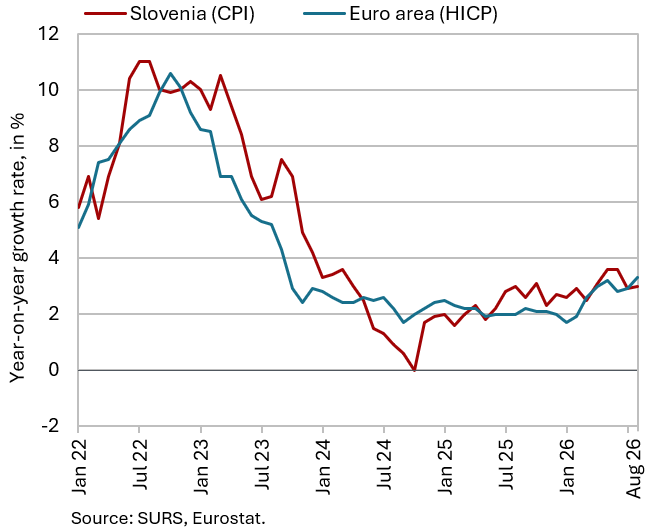
Year-on-year growth in consumer prices edged up slightly in August (to 3.0%), while prices increased by 0.1% month-on-month. The year-on-year contribution to inflation increased mainly in categories that include petroleum products, where price growth strengthened more markedly again in August. Transport (motor fuels) and housing, water, electricity, gas and other fuels (heating oil), which together account for 28.2% of the CPI, contributed a combined 1.8 p.p. to year-on-year inflation. The contribution from services prices also remained high (1.5 p.p.). Year-on-year growth in services prices moderated somewhat in August, largely due to a month-on-month decline in package holiday prices that was unusual for this time of year, but remained relatively high at 4.3%. Prices of semi-durable goods were 0.3% higher year-on-year, while prices of durable goods remained lower than a year earlier (–1.0%). The year-on-year decline in prices of food and non-alcoholic beverages further deepened in August (to –1%), amid a 0.4% month-on-month decline in food prices. HICP inflation stood at 3.4% in Slovenia, 0.1 p.p. above the estimate for the euro area.
Exports and imports of goods, July 2026

Following growth in the second quarter, goods exports and imports declined month-on-month in July (seasonally adjusted), but remained higher than a year earlier. Real goods exports contracted by 2.1% in July, largely due to lower exports to EU Member States, particularly Germany and Italy. Following growth in the second quarter, exports declined in most major product groups, most notably intermediate goods, particularly metal products, industrial machinery and equipment, and some primary products. Exports of pharmaceutical products and road vehicles continued to increase and, amid minor fluctuations, have been rising since the beginning of the year. Goods imports declined markedly in July (–5.6%), which was mainly attributable to lower imports of capital goods and certain intermediate goods (all seasonally adjusted). In the first seven months of the year, goods exports were 6.3% higher year-on-year and imports 5.1% higher. Year-on-year export growth was broad-based, with exports of pharmaceutical products and road vehicles making the largest contributions.
Amid more encouraging signs of recovery among Slovenia’s main trading partners, export orders in manufacturing increased further in July, reaching their highest level in three and a half years, but remained below their long-term average.
Turnover in market services, June 2026
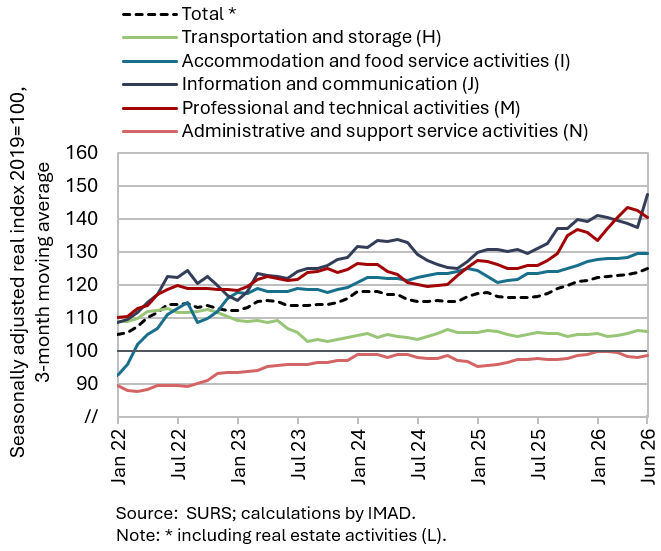
Total real turnover in market services continued to increase in the second quarter (seasonally adjusted) and was also higher year-on-year in the first half of the year. In information and communication, turnover growth, which had previously been weak, accelerated in the second quarter, mainly reflecting higher sales on the domestic market. Turnover growth also strengthened in accommodation and food service activities, amid strong growth in overnight stays by foreign tourists. In transportation and storage, turnover increased slightly again after having largely stagnated over the past three years. Following strong growth at the beginning of the year, turnover in professional and technical activities remained broadly unchanged from the previous quarter. After stagnating at the beginning of the year, turnover in administrative and support service activities declined, mainly reflecting a contraction in employment services (all seasonally adjusted). In the first half of the year, total real turnover was 6.3% higher year-on-year (with the largest increase recorded in professional and technical activities, at 11.3%).