
Charts of the Week
Charts of the week from 18 to 22 May 2026: Slovenian industrial producer prices, number of persons in employment and average gross wage per employee
Industrial producer prices in Slovenia rose by 0.5% month-on-month in April, the largest increase in the past 12 months. Year-on-year growth also strengthened (to 1.4%), driven mainly by higher prices of intermediate and consumer goods, while energy prices (particularly electricity prices) remained lower. The total number of persons in employment remained relatively stable, although there were considerable differences across activities: in March, the year-on-year decline was most pronounced in manufacturing and trade, while employment in public services, particularly health and social work, increased. Year-on-year growth in the average gross wage also remained relatively high in March. In the private sector, this was affected by the large increase in the minimum wage at the beginning of the year, while in the public sector it reflected the implementation of the wage reform. In the first quarter of this year, the average gross wage was thus 4.2% higher in real terms year-on-year, with increases of 3.3% in the public sector and 4.6% in the private sector.
Slovenian industrial producer prices, April 2026
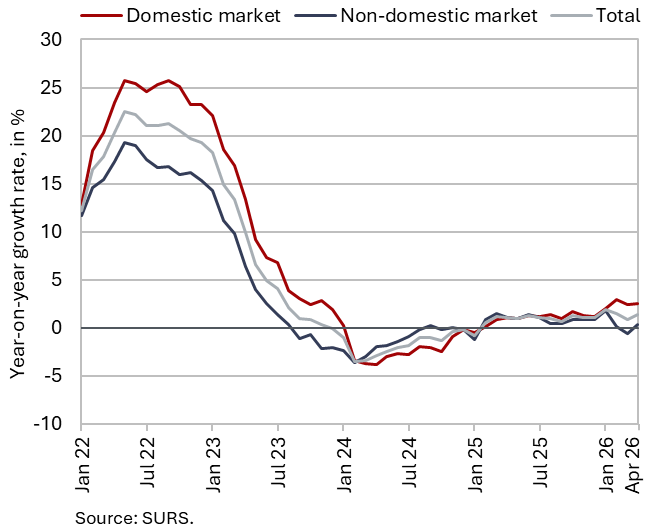
Slovenian industrial producer prices rose sharply in April. Prices increased by 0.5% month-on-month (the largest increase in the last 12 months), while year-on-year growth strengthened by 0.5 p.p. to 1.4%. Year-on-year growth was driven mainly by higher intermediate goods prices (up 1.8%), with consumer goods prices also making a significant contribution (up 1.4%). Although growth in non-durable consumer goods prices (0.4%) slowed in recent months, growth in durable consumer goods prices accelerated (to 5.3%), in our assessment mainly due to higher furniture prices (7.3%). Prices of capital goods increased by 1.1% year-on-year, while energy prices remained lower (–0.8%). The divergence between price growth on the domestic and foreign markets narrowed slightly: in April, year-on-year growth in industrial producer prices on the domestic market (2.5%) remained close to the levels recorded in previous months, while prices on foreign markets (following a decline in March) were again slightly higher year-on-year (by 0.3%).
Number of persons in employment, March 2026
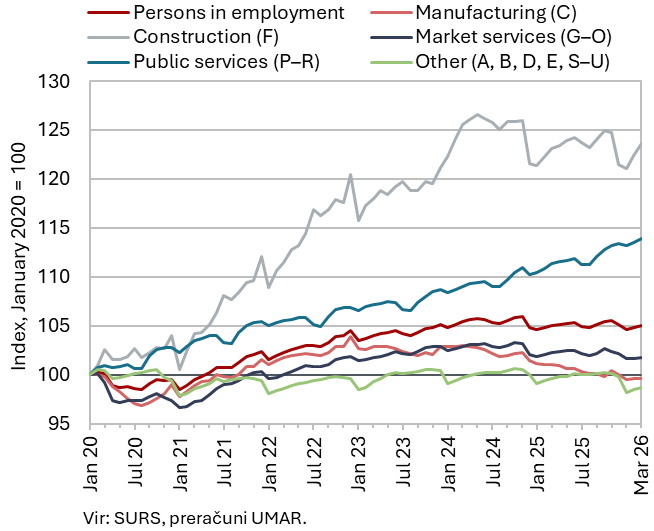
According to the Statistical Register of Employment (SRDAP), the number of persons in employment in March remained broadly unchanged relative to previous months (seasonally adjusted) and compared with a year earlier. The number of employees declined slightly year-on-year (–0.2%), while the number of self-employed increased (0.9%). While the overall number remained relatively stable, significant differences across activities persisted: the largest year-on-year declines in the number of persons in employment were recorded in manufacturing (–1.5%) and trade (–1.3%), whereas employment increased in public service activities, particularly in health and social work (3.6%). The number of foreign citizens in employment increased by 2.6% year-on-year in March, while the number of Slovenian nationals in employment declined by 0.4%, primarily due to retirements.
Average gross wage per employee, March 2026
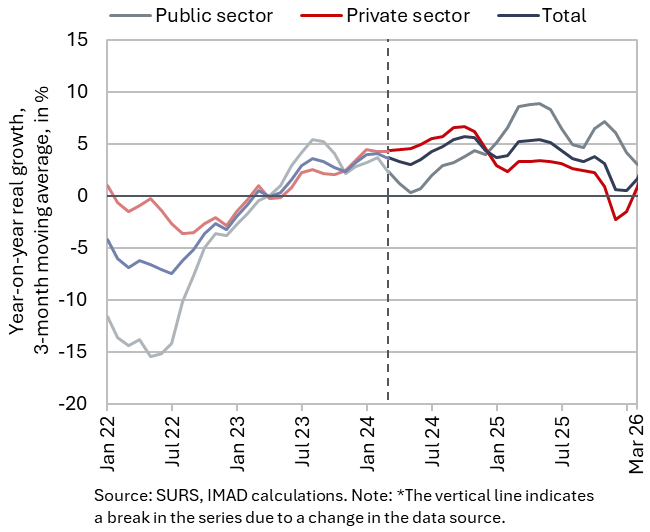
Year-on-year nominal growth in the average gross wage remained relatively high in March (7.3%), with growth similarly high in both the private (7.4%) and public sectors (6.8%). Growth in the private sector was primarily influenced by an increase in the minimum wage at the beginning of the year (+16%). The highest year-on-year wage growth in March was recorded in construction, accommodation and food service activities, and administrative and support service activities (including employment agencies), which are activities with the highest shares of minimum wage recipients. In the public sector, strong wage growth was related to the wage reform, the agreed increases in base wages at the beginning of last year and collective bargaining agreements. In the first three months of this year, the overall average gross wage increased by 4.2% in real terms (7.1% in nominal terms) – by 3.3% in the public sector (6.1% in nominal terms) and by 4.6% in the private sector (7.4% in nominal terms).