News
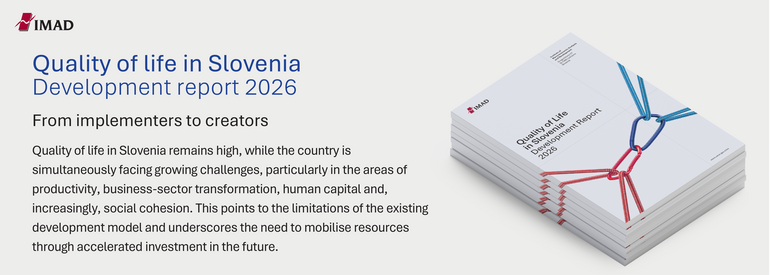
From implementers to creators: Quality of life in Slovenia – Development report 2026
Slovenia continues to maintain a high quality of life; however, rising global pressures, demographic change, limited adaptability and insufficient investment in the future are constraining the full utilisation of its development potential. The Report presents proposals and identifies forward-looking priorities together with a balanced package of policies aimed at positioning Slovenia among the creator economies. Such innovation-driven growth would foster ambitious enterprises, sustainable business models, digitalisation and automation, while being underpinned by upgraded social, integration and related policies that support an open, cohesive and attractive society characterised by a skilled workforce and mutual trust.
According to most global composite indices of quality of life, Slovenia continues to rank among the better-performing EU Member States. Life satisfaction has reached its highest recorded level, while healthy life years remain above the EU average. Owing to high employment, rising incomes, low income inequality and relatively effective social protection systems, living conditions in Slovenia are relatively favourable. Nevertheless, since 2021 the risk of social exclusion has been increasing, particularly among more vulnerable population groups, where multiple dimensions of deprivation tend to overlap. Housing affordability is deteriorating, and the quality of education is also declining.
Slovenia continues to reduce its productivity gap only slowly, which remains a key constraint on faster economic convergence with more developed countries, while pressures on the competitiveness of the economy are increasing. Institutional competitiveness and public trust are below the EU average, further limiting the country’s readiness for change. Slovenia’s natural environment remains relatively well preserved; however, its ecological footprint is still high, primarily owing to the substantial carbon footprint associated with the extensive use of fossil fuels in transport.
In the context of demographic change, rapid technological progress and heightened global uncertainty, increasingly important challenges include the excessively slow transition to innovation-driven growth and a carbon-neutral circular economy, coupled with low social cohesion, shortages of appropriately skilled labour and insufficient emphasis on creativity and the development of key competencies for the future. This points to the limitations of the existing development model and highlights the importance of strengthening future-oriented resources in order to preserve the achieved level of well-being, particularly human capital, productivity and social resilience.
The findings of the Quality of life in Slovenia – Development report 2026 once again underline that more decisive action across several interrelated areas will be crucial for maintaining the achieved level of well-being and ensuring successful development in the future. Priority should be given to:
- strengthening the development and availability of human capital through the upgrading and modernisation of education systems, the development of future skills and the expansion of lifelong learning, while improving linkages between education, the labour market and the innovation system, and strategically attracting talent and other skilled labour;
- improving living conditions for all generations and strengthening social cohesion by increasing the resilience of the public healthcare system, further developing long-term care and ensuring adequate pensions, increasing the effectiveness of social protection systems, implementing active integration and inclusion policies, and improving housing affordability;
- strengthening the transition to a low-carbon circular economy through more effective policy governance, stronger incentives for sustainable investment, accelerated green transformation of the energy sector, industry and mobility, strengthened recycling and a greater strategic role for the bioeconomy.
To achieve these objectives, the above measures must be complemented by:
- accelerating productivity growth and the transition to an innovation-driven economy through the introduction of new business models and technologies in enterprises, supported by greater investment in research, development, innovation and digitalisation, stronger cooperation between research institutions and the business sector, and the upgrading of corporate business strategies; and
- improving the institutional environment and ensuring more development-oriented public finances through better strategic governance, greater transparency and trust in institutions, improvements in the business environment, and more development-oriented and fiscally sustainable long-term public finance management.
______
Quality of life in Slovenia – Development Report 2026 (pdf)