
Charts of the Week
Charts of the week from 1 to 5 June 2026: unemployment, exports and imports of goods
The number of unemployed persons also declined marginally in May (–0.2%, seasonally adjusted). In the first five months of the year, it was 0.4% lower year-on-year. However, the number of unemployed young people has been rising since October 2024, which we assess to reflect the entry of larger cohorts into the labour market amid weaker demand for labour. Real goods exports in April remained broadly unchanged from the previous month (+0.2%, seasonally adjusted), after increasing in the preceding months. Real goods imports, which have fluctuated markedly in recent months, declined significantly (–3.5%). In the first four months of the year, real exports were 2.8% higher year-on-year and real imports 5.7% higher, with one additional working day compared with the same period last year. Amid uncertain international economic conditions, export orders improved slightly in May but remained relatively low.
Unemployment, May 2026

The number of registered unemployed fell slightly month-on-month in May (-0.2%, seasonally adjusted) and was also slightly lower year-on-year (-0.3%). According to original data, 43,060 people were unemployed at the end of May, 2.5% fewer than at the end of April. The year-on-year decline in the number of long-term unemployed and unemployed persons aged over 50 continued (down 5.9% and 3.5% respectively). The number of unemployed young people (aged 15–29), which has been higher year-on-year since October 2024, exceeded its level from a year earlier by 4.1% in May, reaching 8,972 persons. This may be at least partly related to the increase in the size of cohorts entering the labour market (between 2023 and 2025, the number of residents aged 15–29 increased by ten thousand or 3.3%), while demand for labour has weakened. In the first five months of the year, the number of unemployed persons was 0.4% lower year-on-year.
Exports and imports of goods, April 2026
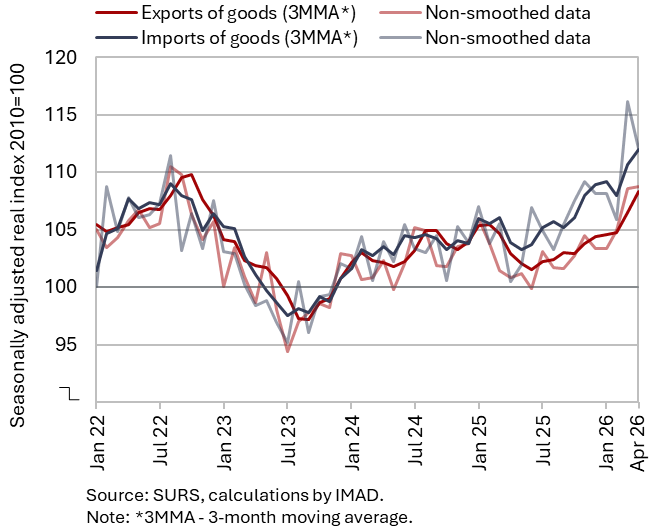
Goods exports remained broadly unchanged in April compared with March, while imports declined; nevertheless, both were higher than a year earlier. Real exports of goods remained broadly unchanged month-on-month in April (+0.2%), following growth in the preceding months. Exports of machinery and equipment (including vehicles) and of metals and metal products increased, while exports of chemical products and pharmaceuticals also rose, albeit to a lesser extent. By contrast, exports of materials (excluding metals and metal products) and primary products declined. Month-on-month, exports increased to Italy and several non-EU countries (the United States, the United Kingdom and Switzerland), while exports to Germany, Austria and France decreased. Real imports of goods fluctuated markedly in recent months. Following strong growth in March, they declined significantly in April (–3.5%), although they remained above the level recorded at the beginning of the year.
Import developments over the past two months were driven primarily by pronounced fluctuations in imports of consumer goods, while imports of intermediate goods continued to increase (all seasonally adjusted). Compared with the same period last year, real exports were 2.8% higher and real imports 5.7% higher in the first four months of the year, with one additional working day compared with the same period a year earlier. The year-on-year increase in the first four months in exports was driven primarily by exports of pharmaceutical products, motor vehicles, and electrical machinery and equipment, while import growth was mainly attributable to the machinery and equipment group as a whole (including motor vehicles), as well as metals and metal products.
Amid highly uncertain international economic conditions, export orders improved slightly in May but remained relatively low.