
Charts of the Week
Charts of the week from 22 to 26 June 2026: economic sentiment, average gross wage per employ and real estate
Economic sentiment improved further in June and, following January, once again rose above its long-term average. Growth in the average gross wage remained relatively strong in April in both the public and private sectors, with the average gross wage over the first four months of the year 7.3% higher on average in nominal terms than in the same period last year. Year-on-year growth in dwelling prices strengthened in the first quarter, while the number of transactions involving existing dwellings continued to increase.
Economic sentiment, June 2026

The economic sentiment indicator, which had fallen to its lowest level since the fourth quarter of 2023 in April, continued to improve in June. It exceeded its level from a year earlier and, for the first time since January this year, also rose above its long-term average. The improvement in June was driven by the confidence indicators for consumers and manufacturing, both of which increased for the second consecutive month. On a year-on-year basis, both indicators were also higher, although the manufacturing confidence indicator remained below its long-term average. The confidence indicators for construction, retail trade and services, all of which remained above their long-term averages, declined in June. In construction and services, where confidence has generally been declining since the beginning of the year, the indicators were also slightly lower than a year earlier.
Average gross wage per employee, April 2026

Year-on-year nominal growth in the average gross wage remained relatively high in April (6.9%), with similar growth rates in the private (6.9%) and public (6.6%) sectors. Wage growth in the private sector was strongly influenced by an increase in the minimum wage introduced at the beginning of the year (+16%). The highest wage growth was recorded in accommodation and food service activities, construction and manufacturing. With the exception of manufacturing, these are among the activities with the highest shares of minimum wage recipients. In the public sector, robust wage growth reflects last year’s wage reform and agreements reached through collective bargaining.
In the first four months of 2026, the average gross wage increased by 7% in nominal terms (4.1% in real terms) – by 6.2% in the public sector (3.3% in real terms) and by 7.3% in the private sector (4.4% in real terms).
Real estate, Q1 2026
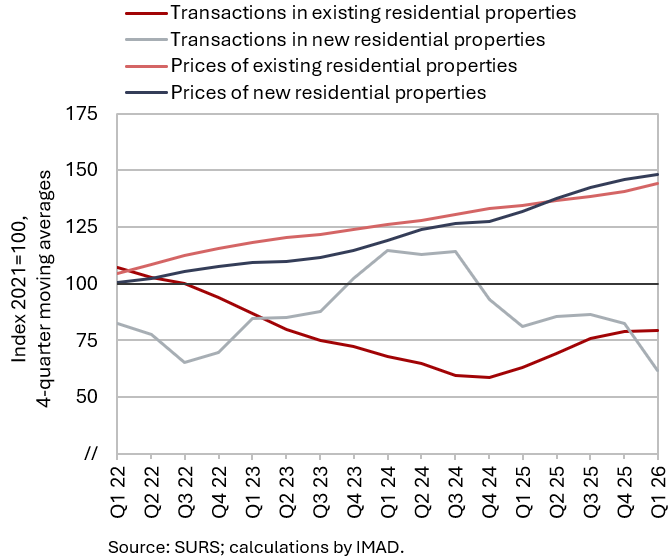
Year-on-year growth in dwelling prices strengthened in the first quarter, amid relatively high transaction volumes. Following average growth of 7.3% in 2025 (after similar increases in 2023 and 2024), dwelling prices were 9.3% higher than in the first quarter of 2025 and 3.0% higher than in the fourth quarter of 2025. Prices of existing dwellings increased by one tenth year-on-year. The number of transactions in this segment, which had already increased by one third year-on-year in 2025 following three consecutive years of decline, continued to rise. Prices of newly built dwellings also increased year-on-year (by 6.8%), while the number of transactions in this segment – which accounts for only a small share of all dwelling transactions (3%) – declined further.